WCO to take part in the 5th World Conference on Creative Economy in Indonesia
World Creativity Organization · 20 October 2026
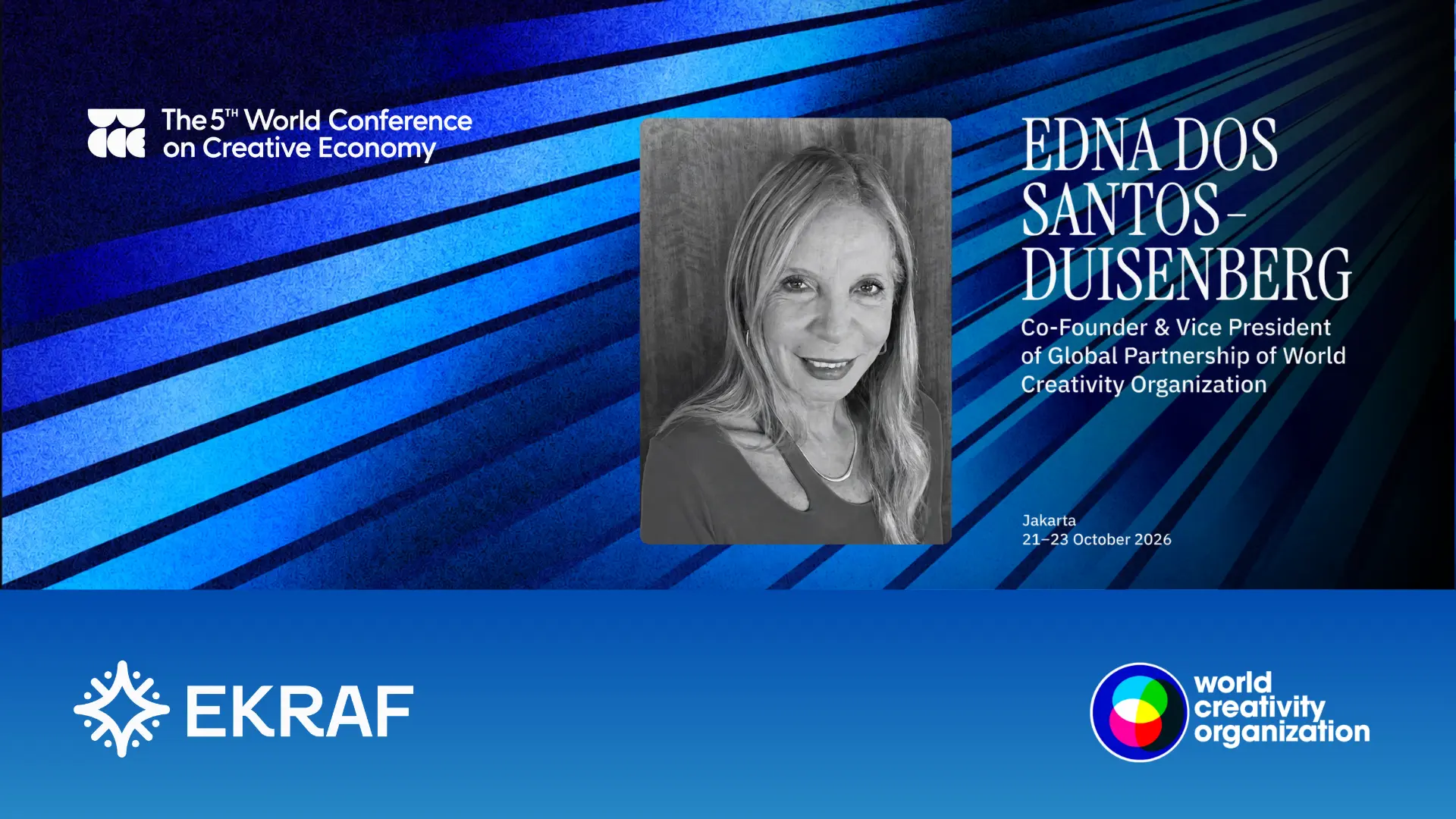
Edna dos Santos-Duisenberg, co-founder and vice-president of the World Creativity Organization, joins the programme for a conversation on building an inclusive economy.
The World Creativity Organization will take the stage at the 5th World Conference on Creative Economy (WCCE), to be held from 21 to 23 October 2026 in Jakarta, Indonesia. Edna dos Santos-Duisenberg, the organization’s co-founder and vice-president, will join a programme dedicated to the relationships between creativity, development and inclusion.
Under the theme “Inclusively Creative: Collective Continuity”, the conference invites reflection on how to expand opportunities for participation in the creative economy and sustain progress built collectively. Its programme brings together representatives of governments, organizations, businesses, academia and creative communities to discuss pathways for the sector.
Creativity and inclusion at the heart of the conversation
On 22 October, Edna is scheduled to participate in the “Building an Inclusive Economy” session at the Kempinski Grand Ballroom. According to the published programme, the conversation will also feature Sinta W. Kandani, president of the Indonesian Employers Association (APIINDO).
The theme raises a fundamental question: how can the potential of creativity be transformed into economic opportunities that reach more people and communities?
For WCO, this discussion connects with its purpose of expanding access to creativity, encouraging leadership development and bringing together people and institutions capable of turning ideas into concrete initiatives. Inclusion involves creating conditions for diverse talents to contribute to value creation and find pathways to develop their capabilities.
A career connected to the international creative economy agenda
In the announcement of her participation, the organizers highlight Edna’s career as a Brazilian economist and former international diplomat at UNCTAD, with a pioneering role in the United Nations’ work on the creative economy.
The introduction notes that Edna established and led UNCTAD’s Creative Economy Programme between 2004 and 2012 and led the Creative Economy Reports of 2008 and 2010. This work helped consolidate the debate on the relationships between creativity, trade, job creation and inclusive development.
Her participation in the conference connects this experience with her current work as an international consultant, adviser on creative economy and development policies, and co-founder of the World Creativity Organization.
An agenda bringing culture, technology and development together
The WCCE programme reflects the diversity of activities and challenges that make up the creative economy. Announced topics include public policy, intellectual property, investment, education, artificial intelligence, design, gastronomy, games and creative communities.
This breadth highlights the importance of connecting creative skills with the conditions for development: training, access to markets, protection of authorship, financing and collaboration across sectors.
The sessions on artificial intelligence and the future of education also point to the need to discuss how technological transformations affect work and learning. In this context, developing human capabilities and expanding access to knowledge become essential parts of the conversation about the future of the creative economy.
Connecting global debate with action in local communities
For the World Creativity Organization, taking part in this international agenda represents an opportunity to exchange insights on challenges shared by different countries and communities.
The connection between global debate and action in local communities is particularly relevant to an organization that develops initiatives to mobilize people, provide education and recognize the value of creativity. Local experiences can contribute to international discussions, while the exchange of knowledge can offer new perspectives for projects, leaders and networks.
Edna dos Santos-Duisenberg’s participation in WCCE is part of this movement of dialogue. By bringing together inclusion, creativity and development, the conference creates space for a question that also guides WCO’s work: how can we create conditions for more people to turn their creative potential into opportunities and achievements?